

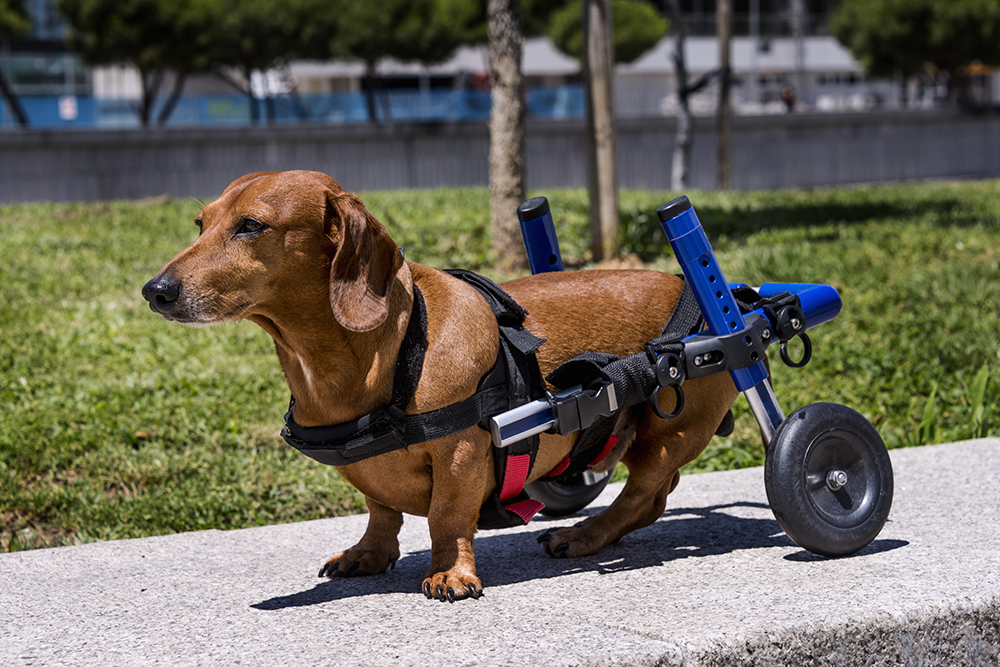
For a lot of dogs, the answer is more hopeful than families expect: a harness or a cart can restore real, meaningful mobility, even if it is not always the exact stride they had before. Some dogs are recovering from an injury or surgery and will walk well again. Others are living with a chronic or progressive condition that will not fully reverse, and for them the goal is keeping mobility, comfort, and independence while preventing the falls, muscle loss, and strain on the other limbs that pile up when a weak dog struggles without help. In both cases, the right support depends on what caused the problem, how early you start, and whether the device is paired with rehabilitation. The device handles the mechanics. Rehabilitation is what builds the strength behind it and helps a dog hold onto it.
Memorial Villages Animal Hospital in Houston is one of the few general practices with a full rehabilitation facility on-site. Our rehabilitation services include an underwater treadmill, cold laser and shockwave therapy, neuromuscular electrostimulation, acupuncture, chiropractic care, and regenerative medicine, all working alongside mobility aids to help dogs rebuild and hold onto function. We also handle pain management and individualized planning, and we can send your dog to the specialists next door when an advanced orthopedic evaluation is needed. If your dog is struggling to walk and you want to see every option, call us and we will build a plan around what your dog actually needs.
What Matters Most About Mobility Support
- Support is not only for recovery: many dogs use harnesses, carts, and rehab to stay mobile with chronic or progressive conditions, not just to bounce back from an injury.
- Devices and rehab work as a pair: the harness or cart supports the mechanics, while rehab rebuilds and maintains the muscle that walking depends on.
- Starting early prevents new problems: support added before a dog is badly struggling helps avoid the falls, muscle loss, and strain on the other limbs that speed decline.
- The right device matches the level of need: traction aids early, a harness in the middle, a cart when the legs can no longer hold weight.
Can a Device Actually Restore Walking?
For many dogs, yes, and for others the goal is maintaining mobility rather than fully restoring it. A dog whose trouble is pain from osteoarthritis may simply need support and pain control to move comfortably again, while a dog with permanent nerve damage may keep its freedom with a cart. The honest framing is meaningful mobility, whether that means walking again or staying on the move for as long as possible.
What consistently improves the odds is starting early and pairing the device with rehabilitation. Muscle wastes quickly once a dog stops using a limb, and lost muscle is the hardest part to rebuild. For a dog with a progressive condition, support that keeps them moving also slows that cascade and protects the other legs from the strain of compensating, which is why both the early weeks after an injury and the first signs of decline matter so much.
How Do My Dog’s Support Needs Change Over Time?
Support needs tend to move along a spectrum, and the right tool shifts with them. Early on, a dog that just slips or slows down needs traction and a few home changes. As weakness grows, a harness steadies the hard moments. When the legs can no longer hold weight, a cart restores independence. Naming where your dog sits right now helps match the support to the need.
| Stage of need | What you might notice | Support that helps | Goal |
| Early or mild | Slipping on floors, stiffness, slowing on stairs | Traction aids, home changes, joint support | Prevent falls and keep muscle |
| Moderate | Needs a boost to rise, tires on walks, wobbles in the rear | Support harness, pain control, rehabilitation | Steady the hard moments, protect the other limbs |
| Advanced or permanent | Cannot reliably stand or push off with the rear legs | Mobility cart, full-body harness | Restore independence and quality of life |
Some dogs move through these stages slowly over years as a condition progresses, while others arrive at one suddenly after an injury and then move back toward less support as they recover. Either way, thinking in stages helps you plan for what your dog needs now and what may be coming next.
Which Conditions Typically Need Support Devices?
Diagnosing the condition behind the change tells you whether support is about recovery or lifelong management, and how it is likely to evolve. Some problems improve with a harness and rehab over a few months. Others are progressive, so the work is staying ahead of the decline and preventing the secondary problems that often make a dog worse faster than the disease itself.
- Arthritis: the most common reason dogs need mobility support, and a condition that is managed rather than cured. Traction and a harness make everyday movement easier, while pain control, weight management, and rehab protect the joints and help head off the falls and muscle loss that speed things along.
- Intervertebral disc disease and fibrocartilaginous embolism: both can cause sudden weakness, but they often carry a strong outlook. The non-progressive FCE in particular tends to respond well to a harness plus rehab, though a few dogs keep using a cart long-term.
- Degenerative myelopathy: progressive and not reversible, so support climbs over time from traction aids to a harness to a cart. The aim is preserving function and comfort for as long as possible while keeping the rest of the body strong as the disease advances.
- Hip dysplasia: usually very manageable with rehab, weight control, and pain care, with a harness softening transitions like stairs and rising. Some dogs benefit from surgery when appropriate.
- Amputation: after osteosarcoma or trauma leads to amputation surgery, most dogs adapt to life on three legs within weeks, though some need balance support while they learn.
How Can I Improve My Dog’s Stability or Prevent Slipping?
Dogs with muscle weakness or nerve trouble often start slipping on smooth floors well before they need a harness or cart, and those falls can cause new injuries that set everything back. Adding traction is one of the simplest, highest-value ways to prevent that, keep your dog confident, and protect the progress you are working toward.
- Traction underfoot: rubber toe grips and traction booties give slippery feet something to hold onto on hard floors.
- Foot placement: for dogs whose rear paws drag or knuckle over, knuckling socks help correct foot placement so they relearn a normal step instead of reinforcing a scuff.
- Strength and coordination: progressive resistance bands help guide foot placement for dogs with hind-end weakness while building strength at the same time.
- Rugs and runners: laying rugs or runners along the paths your dog uses most, like the route to the water bowl or the back door, turns slick floors into safe footing and cuts down on falls.
What Happens When My Dog First Needs a Harness?
A support harness usually becomes the right tool when a dog needs a steadying hand to rise, manage stairs, or get through a wobbly walk, whether that is after surgery or as a chronic condition slowly takes hold. It supports weight without strain while the dog keeps using its legs, which protects both muscle and confidence. The style depends on where the weakness sits.
After surgery, a disc episode, or a sudden spinal event, the priority is support without strain. For dogs with progressive weakness or balance problems, a harness plus your support can give them the confidence to enjoy a walk with you again rather than giving up on it.
- Rear-support styles: a rear-end harness lifts the hips for help over stairs and short, careful walks.
- Front-support styles: work well for dogs with shoulder or elbow pain, or those recovering after a front-limb amputation.
- Full-body styles: support harnesses and full-body lift harnesses steady front and rear for a dog weak in more than one limb or just out of surgery.
In this stage, sessions are short and frequent, fit is checked carefully to avoid rubbing on healing or sensitive skin, and the goal is preventing muscle loss rather than pushing for distance.
When Does a Cart Become Part of Walking Again?
For some dogs, walking again means a mobility cart rather than a return to unaided movement, and that is still a genuine win. When rear-limb function will not come back, whether from a permanent injury or a progressive disease, a well-fitted cart restores the freedom to move, sniff, and keep up with the family. It is for active outings rather than all-day use, and most dogs take a week or two of short, upbeat sessions to settle in. Plenty of dogs in carts log happy, active years, especially when the cart is paired with ongoing rehab to keep the rest of the body strong and prevent new strain.
How Does Rehabilitation Rebuild Strength?
Rehabilitation rebuilds strength by getting weakened muscles working again in a controlled, low-risk way, and for dogs with a lasting condition it works just as hard to maintain the strength they still have. Veterinary physical rehabilitation uses water, electrical stimulation, and targeted exercise to wake up muscle, retrain coordination, and protect joints, so that supported steps turn into stronger, steadier walking.
Memorial Villages Animal Hospital is one of the few general practices in Houston with a full on-site rehabilitation facility, which means your dog can move from diagnosis to active care without bouncing between buildings. Here is how the strength-building tools work hand in hand with a harness or cart.
The Underwater Treadmill
The underwater treadmill is often the centerpiece of strength work. A treadmill sits inside a chamber that fills with warm water, and the buoyancy carries much of your dog’s weight so sore joints take far less load with every step. The water adds gentle resistance that builds muscle, while the warmth loosens stiff muscles and eases discomfort. We can raise or lower the water level to control exactly how hard your dog is working, which makes it ideal for a dog who is too weak or too painful for exercise on dry ground. Paired with a support harness during the same stretch of care, the treadmill rebuilds the very muscle the harness is holding up, so your dog needs less assistance over time.
Neuromuscular Electrostimulation
When nerve signals are impaired by a disc injury, an FCE, or surgery, muscles can stop firing properly and waste away even when a dog wants to use them. Neuromuscular electrostimulation sends gentle electrical pulses through pads on the skin to make those muscles contract on their own. It keeps muscle alive, re-educates the connection between nerve and muscle, and is one of the most useful tools we have for dogs whose legs are not yet doing what their brain is asking. For a dog spending the early weeks in a harness or cart, this is often what preserves the strength that makes later walking possible.
Targeted Exercise and Resistance Work
Hands-on therapy fills in what the machines cannot. Guided exercise and targeted strength work rebuild specific muscle groups and retrain balance and coordination. We adjust the difficulty as your dog gains strength, which keeps progress moving forward without pushing a healing or aging body past what it can handle.
Which Therapies Ease Pain and Speed Healing?
Some therapies do not build muscle directly. They make movement possible by lowering pain and inflammation so your dog can actually do the work, which matters just as much for a dog managing a lifelong condition as for one healing from surgery. Easing pain also keeps a dog active, and an active dog holds onto muscle and sidesteps the downward spiral that inactivity creates.
Cold Laser Therapy
Cold laser therapy uses focused light energy to reduce inflammation, dull pain, and stimulate healing at the cellular level. It is painless and needs no sedation, so most dogs relax right through a session, which lets us use it on incision sites and sore joints throughout care.
Shockwave Therapy
Shockwave therapy delivers focused acoustic pressure waves into a problem area to boost blood flow, recruit the body’s own healing factors, and ease chronic pain. It works especially well for arthritis, tendon and ligament injuries, and stubborn sore spots, and because the pulses can feel intense, we often pair it with light sedation so your dog stays comfortable.
Pulsed Electromagnetic Field Therapy
Targeted pulsed electromagnetic field therapy uses low-level electromagnetic pulses to quiet inflammation and pain while supporting tissue repair. It is non-invasive and needs no sedation, which makes it a gentle addition for arthritis flares, post-surgical pain, and nerve inflammation that layers easily alongside your dog’s other therapies.
Regenerative Medicine
For chronic joint problems, regenerative medicine targets the underlying damage rather than only the symptoms. Platelet-rich plasma (PRP) concentrates the healing platelets from your dog’s own blood and injects them into the damaged joint, where they lubricate the joint, help preserve cartilage, and calm inflammation. Because it uses your dog’s own blood, it is minimally invasive with essentially no side effects, and it fits arthritis, dysplasia, and soft tissue injuries where keeping a joint working matters for the long haul.
Acupuncture
Acupuncture eases pain and supports nerve function, which is especially valuable for dogs with spinal injuries or chronic weakness. We offer traditional, electrical, and aqua-acupuncture, and most dogs find it relaxing alongside their other therapies.
Chiropractic Care
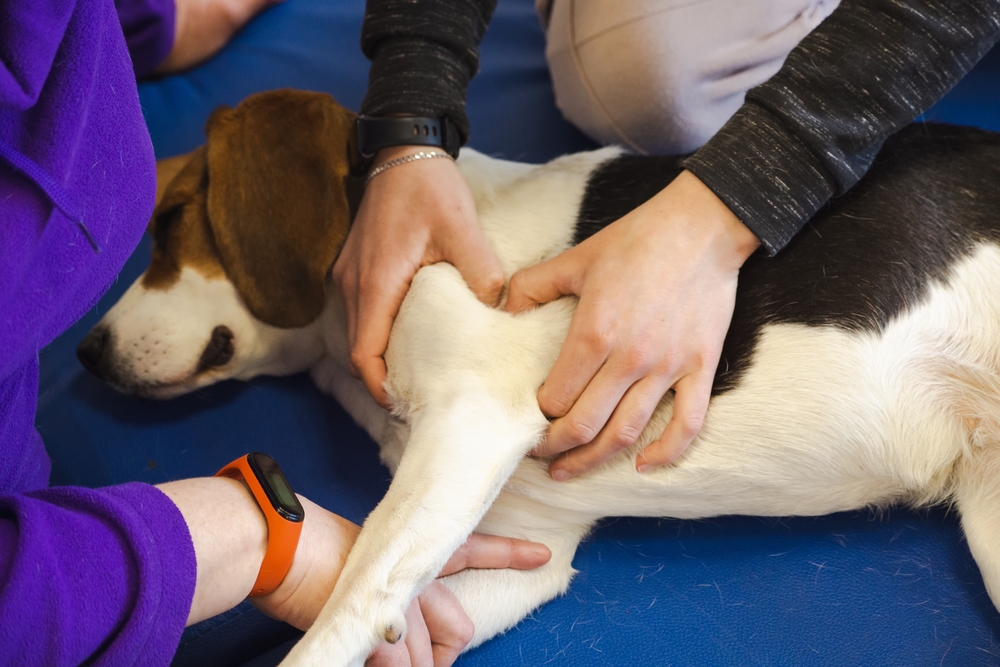
Our veterinary chiropractic care starts with an exam to find the joints that have lost their normal motion, then adjusts one vertebra at a time, only where it is needed, in a quick 10 to 15 minute session with your dog standing or sitting comfortably. Most dogs find it feels good and many improve quickly, though long-standing problems take a series of visits. It is worth considering when a dog struggles with stairs, holds the tail to one side, stands with the legs looking uneven, or moves with a stiff, sore posture.
What Else Goes Into a Mobility Plan?
A device and rehab are only part of the picture. Comprehensive mobility management layers several more pieces, and for a dog with a chronic or progressive condition, that broader plan is what keeps small problems from snowballing into bigger ones. It usually includes:
- Pain control: anti-inflammatories, monoclonal antibody injections such as Librela for dogs and Solensia for cats, and other medications matched to the cause.
- Weight control: the single highest-leverage change for almost every joint condition, since every extra pound multiplies the load a sore joint has to carry.
- Consistency at home: short, regular sessions between visits hold the gains rehab makes in the clinic.
When Is Trouble Walking an Emergency?
Most mobility loss develops slowly, but some does not. Sudden paralysis, a paw that knuckles under and stays, or a dog that cannot bear weight at all can mean an acute spinal event that needs same-day emergency or urgent care. Call ahead and come in right away rather than waiting overnight, because the early window often matters for recovery.
Frequently Asked Questions About Walking Again
Does Rehabilitation Really Help, or Is the Cart Enough?
Rehabilitation makes a real difference. A device supports the mechanics of moving, but rehab maintains and rebuilds the muscle that actual walking depends on, and pairing the two beats either alone. Our on-site underwater treadmill is especially useful for dogs who cannot yet tolerate land-based exercise.
How Many Rehabilitation Sessions Will My Dog Need?
It depends on the diagnosis and how your dog responds, but most rehab plans run as a series rather than a single visit, often starting with one or two sessions a week and tapering as strength returns. Some conditions need a defined stretch of therapy, while chronic problems do best with ongoing maintenance. We set checkpoints and adjust as your dog progresses.
How Soon After Surgery or Injury Should Support Start?
Usually early, under guidance. Gentle, supported movement in the first weeks prevents the muscle loss that is hardest to reverse later. We will tell you when and how much, since pushing too hard too soon can set healing back as surely as doing nothing.
Will My Dog Walk Exactly Like Before?
Sometimes, and sometimes the goal is meaningful mobility rather than an identical stride, especially with a chronic or progressive condition. Many dogs return to comfortable, active lives that look very close to normal, while others thrive with ongoing support. Either way, the aim is a dog who moves, explores, and stays engaged.
How Long Before We See Progress?
It varies with the cause and the starting point, but many dogs show small gains within the first few weeks of combined support and rehabilitation, with steady improvement over the following couple of months. Spinal recoveries in particular tend to be slow and uneven, with good days and the occasional setback along the way. Rather than guessing, we set clear checkpoints so progress is measured, and we adjust the plan as your dog responds instead of holding to a fixed finish line. Consistency at home between sessions is often what separates a strong recovery from a stalled one.
Walking Forward Together
Whether the path is a harness, a cart, or a season of rehabilitation, most dogs keep far more mobility than families expect when the support, the timing, and the rehab line up. For long-term and progressive conditions especially, pairing the right assistive device with our on-site rehabilitation, pain management, and regenerative medicine is what keeps a dog moving comfortably and heads off the falls and strain that make things worse. It starts with a clear picture of what changed and a plan built for this dog at this stage.
If your dog is struggling to walk or you are seeing the early signs of mobility loss, book online or reach out to us and we will work through it together.




Leave A Comment