


Houston’s warm, humid climate means pets here are exposed to allergens year-round, from fire ant stings in the backyard to pollen that never fully lets up. When your dog breaks out in hives after a trip to the park or your cat’s face starts swelling minutes after swatting at a bee, it is completely reasonable to wonder whether you are dealing with a mild reaction that will pass or something that needs immediate veterinary attention. The honest answer is that the gap between “mild and manageable” and “this is an emergency” can close faster than most families expect, sometimes within minutes.
Memorial Villages Animal Hospital provides emergency and urgent care during regular hours for exactly these situations. If your pet is having an allergic reaction, call us so our team can prepare for your arrival. For pets with recurring allergies, our in-house lab work helps us get to the root of what is triggering the reaction and create a management plan tailored to your pet. Book an appointment online to discuss your pet’s allergy concerns.
What Triggers Allergic Reactions in Dogs and Cats
Allergic reactions in pets come from three main categories of triggers, and each tends to produce a different symptom pattern.
Environmental allergens including pollen, mold spores, dust mites, and storage mites cause atopic dermatitis, the chronic immune overreaction that drives most long-term allergy cases. These reactions typically produce itching, recurring ear infections, and skin inflammation rather than sudden emergencies. In Houston’s Gulf Coast environment, the combination of heat, humidity, and long growing seasons means allergen exposure runs nearly year-round.
Food allergies are immune reactions to specific dietary proteins (chicken, beef, dairy, and fish are the usual suspects). They can develop at any age, even in pets who have eaten the same food for years, and they typically produce year-round itching, recurring ear infections, and sometimes GI symptoms.
Insects and parasites cause both chronic and acute reactions. Flea allergy is a hypersensitivity to proteins in flea saliva, where a single bite can trigger weeks of itching. Fire ant stings are especially common in the Houston area and can cause anything from local swelling to rapid systemic anaphylaxis. Bee and wasp stings carry similar risks, and pets who have reacted significantly to a sting before are at higher risk for more severe reactions to subsequent stings.
Vaccine and Medication Reactions in Pets
Vaccination reactions are worth knowing about separately because they are the most common type of medication-related allergic reaction. They range from mild (low-grade fever, soreness at the injection site, reduced energy for 24 to 48 hours) to significant (facial swelling, hives, vomiting) to, in rare cases, severe anaphylaxis. Most reactions appear within 30 to 60 minutes of vaccination, though some develop over several hours.
At Memorial Villages Animal Hospital, pets with a prior vaccination reaction receive a modified protocol: we’ll pre-medicate to lower the risk of a reaction, vaccines are given separately over multiple visits, and we monitor for a period following administration. Sharing your pet’s complete reaction history during wellness visits helps us plan appropriately and keep future vaccinations as low-risk as possible.
Reading Allergic Reactions: How Urgent Is This?
Not every allergic reaction is an emergency, and not every allergy case is chronic. Broadly, the reactions we see fall into three urgency tiers:
- Chronic reactions to manage: ongoing itch, recurring infections, skin and coat issues. These need a structured treatment plan but not an emergency visit.
- Reactions that may need same-day care: hives, mild to moderate swelling, asthma flares, insect stings without systemic signs.
- Emergency anaphylaxis: whole-body immune reactions that can become life-threatening within minutes.
Knowing which tier you are dealing with is what guides the decision between scheduling an appointment, driving in this afternoon, and calling us from the car right now.
Chronic Skin Reactions in Dogs
Most dogs with allergies deal with skin reactions that concentrate on the paws, face, ears, armpits, belly, and groin. Dogs chew their paws, rub their faces on the carpet, scratch at the belly, and develop recurring ear infections. When the itch goes unmanaged, self-trauma damages the skin barrier, which lets in bacteria and yeast, which causes secondary infections, which drive more inflammation and more itching. The cycle builds on itself, and by the time many families arrive at the vet, there are several problems stacked on top of each other.
Chronic Skin Reactions in Cats
Allergic skin disease in cats is easy to miss because cats rarely scratch in the dramatic way dogs do. Instead, feline allergies usually show up in three specific patterns:
- Overgrooming: smooth, symmetric patches of hair loss, most often on the belly, inner thighs, and flanks. Many families do not realize their cat is overgrooming until they notice the bald spots, because cats often do their grooming privately.
- Miliary dermatitis: tiny, crusty bumps scattered through the coat, most often along the back and around the neck. Running your fingers through the fur reveals what feels like grains of sand or small scabs.
- Eosinophilic granuloma complex: raised, firm lesions on the lips, belly, or thighs that can look alarming and are often mistaken for tumors, infections, or injuries. These are an allergic reaction, often to fleas, not a cancer.
Contact Hypersensitivity
Not every reaction involves inhaled or swallowed allergens. Contact hypersensitivity develops when the skin reacts directly to something it touched: laundry detergent on freshly washed bedding, fabric softener on a favorite blanket, certain shampoos or grooming products, cleaning chemicals on hard floors, or even certain plants. The telltale pattern is redness and itching on the parts of the body that actually make contact with the surface: belly, paws, chest, inner thighs, and chin. The fix is often as simple as switching products, though identifying the culprit can take some detective work.
Hives, Respiratory Symptoms, and Insect Stings That May Need Same-Day Care
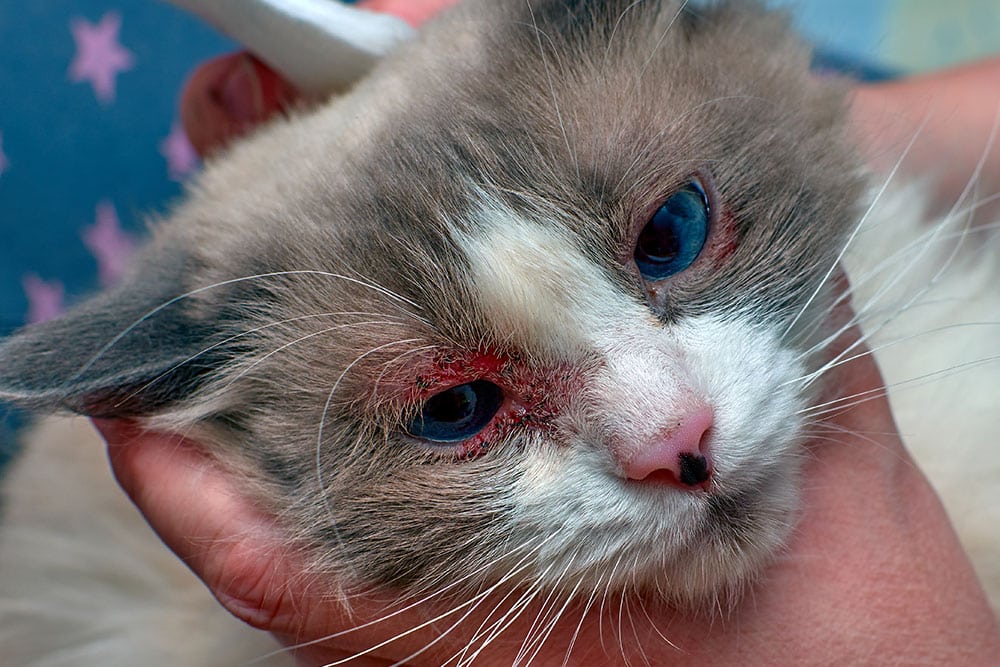
Hives appear as raised, firm, itchy welts distributed across the skin surface, often most visible on the face, neck, and belly, and sometimes with the coat standing up over affected areas. Hives by themselves are uncomfortable but generally not dangerous. They become concerning when they are combined with any sign of swelling around the face or throat, breathing changes, vomiting, or weakness. In those cases, the reaction is escalating and needs same-day care.
Respiratory symptoms also earn special attention. For cats, asthma is a common allergy-related condition that produces coughing, wheezing, and labored breathing. Feline asthma flares can progress quickly, and a cat in respiratory distress needs prompt evaluation.
Insect stings are usually minor (a little local swelling that resolves on its own), but a sting can cross into urgent territory when there is rapid widespread swelling, hives beyond the sting site, breathing changes, vomiting, or weakness. In Houston, fire ants are the biggest offender, and any pet who has reacted strongly to a previous sting deserves extra caution.
Anaphylaxis: The Actual Emergency
Anaphylaxis in dogs and anaphylaxis in cats are whole-body immune emergencies that can develop within minutes of exposure to a trigger. Blood pressure drops, airways constrict, and oxygen delivery to organs fails. Without treatment, anaphylaxis can be fatal within 30 to 60 minutes.
The species-specific presentation matters:
- In dogs: GI signs (sudden vomiting, diarrhea) are often the first obvious indicator, followed by weakness, collapse, and breathing changes.
- In cats: respiratory signs dominate. Open-mouth breathing in a cat is always an emergency regardless of context, and anaphylaxis in cats often involves severe respiratory distress, pale gums, and collapse.
Warning Signs That Require Immediate Veterinary Attention
If you see any of these, call us at (346) 369-7588 while you are heading in:
Emergency now:
- Sudden severe facial or throat swelling, especially if breathing changes
- Pale, white, or blue-gray gums (check by lifting the lip; pale gums signal poor circulation and require immediate care)
- Collapse or sudden inability to stand
- Rapid, labored, or noisy breathing
- Open-mouth breathing in a cat
- Profound weakness alongside any other reaction sign
- Persistent vomiting or diarrhea combined with any of the above
Same day:
- Hives that are spreading or accompanied by facial swelling
- Moderate facial swelling without breathing changes
- Persistent intense itching with broken skin or bleeding
- Sting reactions that are worsening rather than improving
- A known insect sting in a pet with a prior serious reaction
For after-hours emergencies, the emergency and urgent care line reaches our team during business hours. Outside of those hours, head directly to the nearest 24-hour emergency hospital.
What to Do While Getting to the Vet
While you are arranging to come in:
- Remove the suspected trigger if identifiable and accessible: rinse skin with cool water if contact occurred, move the pet away from the environment
- Keep your pet calm and still: activity increases circulation and spreads allergens faster
- Apply an Elizabethan collar if intense scratching is causing skin trauma
- Document the timeline: when symptoms started, what the pet was exposed to, how symptoms have changed
- Photograph any swelling or hives to show our team on arrival
- Call us on the way at (346) 369-7588 so we can prepare the right treatment
Do not give human antihistamines (Benadryl, Zyrtec, Claritin) without calling us first. Some are safe at specific doses for pets; others contain ingredients (like decongestants or sugar substitutes) that are dangerous. We can give you the right dose for your pet’s weight in about 30 seconds over the phone if it’s the right move.
How Allergic Reactions Are Treated
Treatment looks very different depending on whether we are dealing with an acute reaction or chronic disease.
Treating Acute and Emergency Allergic Reactions
Epinephrine is the treatment for anaphylaxis. It reverses airway constriction, raises blood pressure, and stabilizes the cardiovascular response within minutes. Antihistamines, corticosteroids, and IV fluids support recovery. Oxygen therapy is used when respiratory distress is part of the picture.
One detail families often do not know: biphasic reactions can occur, where a pet appears to recover and then has a second wave of symptoms four to eight hours later as the initial treatment wears off. For this reason, we typically monitor pets in the clinic for a period after treatment before sending them home, even when they look fine.
For pets with a history of anaphylaxis, we may discuss keeping an epi-pen at home and training family members to use it in case of another exposure.
Treating Chronic Allergic Skin and Ear Disease
Chronic allergy care is a completely different approach. Ear cytology and skin cytology identify whether bacteria, yeast, or both are contributing to the current flare. Otitis externa is so common in allergic pets that it is often the presenting complaint, and treating the infection without addressing the underlying allergy almost guarantees it will come back.
The guiding principle: chronic allergic disease is managed, not cured, and treating episodes without addressing the root cause means more episodes. A solid long-term plan combines symptom control, infection management, and targeted therapy for the underlying allergy.
Preventing Allergic Reactions and Managing Chronic Allergies
Effective allergy management is layered. No single piece does it on its own, but combining several approaches usually produces real comfort.
Parasite Prevention for Allergic Pets
Flea allergy dermatitis is triggered by a single flea bite in a sensitized pet. In Houston’s climate, fleas are active every month of the year, and a single gap in prevention can set off weeks of misery. Year-round parasite prevention is non-negotiable for any allergic pet, and every pet in the household needs to be covered, not just the allergic one.
Prescription Allergy Medications for Dogs and Cats
Apoquel and Zenrelia block the itch signaling pathway for fast, reliable daily control in dogs. Cytopoint injection neutralizes the primary itch-driving protein for 4 to 8 weeks per dose, also for dogs. Atopica provides immune-level modulation and is one of the few allergy medications well suited to cats. Corticosteroids remain genuinely useful for severe acute flares and bridging while slower medications reach full effect, though long-term daily use is avoided when alternatives are available.
Allergy Testing and Immunotherapy
When symptoms do not respond adequately to medication or when the goal is to move away from long-term medication dependence, allergy testing identifies the specific allergens involved. Validated testing is done through blood testing or intradermal skin testing (not at-home saliva or hair tests, which are not accurate). From there, immunotherapy retrains the immune system over months to tolerate those allergens rather than react to them. It is the most durable long-term option for environmental allergies, with success rates of 60 to 80 percent in well-selected patients.
Grooming, Topical Treatments, and Nutrition Support
Regular grooming physically removes allergens from the coat, reducing overall allergen load. Topical therapies support the skin barrier, treat surface infections, and can reduce how much systemic medication your pet needs. Routine ear cleaning with an appropriate veterinary solution prevents the secondary infections that plague allergic ears, and periodic monitoring of anal glands catches the flare-ups that often accompany allergic skin disease.
Our pharmacy carries:
- Epi-Soothe Shampoo, DermAllay Oatmeal Shampoo, and Spray Conditioner for regular bathing of sensitive skin
- DOUXO S3 CALM Shampoo and Mousse for higher-powered anti-itch, skin healing ingredients
- Epi-Otic Advanced ear cleaner for allergy-prone pets with recurring ear involvement
Omega fatty acids support skin barrier health from the inside and reduce systemic inflammation over time. They pair well with diet trials and other allergy management approaches, and most allergic pets benefit from daily supplementation regardless of which trigger turns out to be primary. Check our pharmacy for omega-3 supplementation options, or dog skin and coat diets and cat skin and coat diets that have omegas and other skin-supporting nutrients built in.
Identifying and Managing Food Allergies in Dogs and Cats
Food allergy is diagnosed through one method: a proper elimination diet trial using a novel or hydrolyzed protein diet for 8 to 12 weeks. Strictness is not optional. During the trial, nothing else enters the pet’s mouth: no treats, no table scraps, no flavored heartworm chews, no stealing from the other dog’s bowl. If symptoms improve during the trial and return when the original food is reintroduced, food allergy is confirmed.
This is where a lot of at-home trials fail. A single “just this once” treat can undo weeks of hard work, which is why we walk families through the logistics carefully before starting and check in regularly along the way.
Frequently Asked Questions
What is the difference between hives and anaphylaxis?
Hives are raised, itchy skin welts that are uncomfortable but typically not dangerous on their own. Anaphylaxis is a sudden whole-body reaction causing respiratory distress, circulatory collapse, and potentially death within minutes. Hives can sometimes be managed with monitoring and antihistamines; anaphylaxis requires immediate emergency care. The key clue is whether other signs (swelling, breathing changes, vomiting, weakness, pale gums) are present alongside the hives.
Can I give my pet Benadryl at home?
Some antihistamines are safe at specific doses, and others contain ingredients that are toxic to pets. Before giving anything, call us for dose guidance based on your pet’s weight and the specific product you have. It takes us about 30 seconds to tell you what is safe.
My pet had one severe reaction. Will the next one be worse?
It can be. Pets who have had significant anaphylaxis are at higher risk for severe reactions to subsequent exposures to the same trigger. We talk through avoidance strategies, whether having an epi-pen at home is appropriate, and what to do in case of future exposure.
How do I know if my pet’s ear problem is actually allergies?
Allergic ears tend to be recurrent. They clear up with treatment and come back within weeks to months, often with other skin symptoms (itchy paws, belly redness, face rubbing). Isolated one-time ear infections usually are not allergies, but repeating ear problems almost always point to an underlying allergic cause that needs addressing.
Long-Term Allergy Care for Dogs and Cats
Allergic reactions range from completely manageable to life-threatening, and the difference can appear quickly. The most effective management addresses the root cause rather than just putting out the fires when they flare, which takes a long-term partnership with a veterinary team who knows your pet. Whether you need emergency care right now, same-day help for a concerning reaction, or a thoughtful long-term plan for chronic allergy disease, we are here for all of it.
Book an appointment to discuss chronic allergy management, or contact us with questions about your pet’s recent reaction.